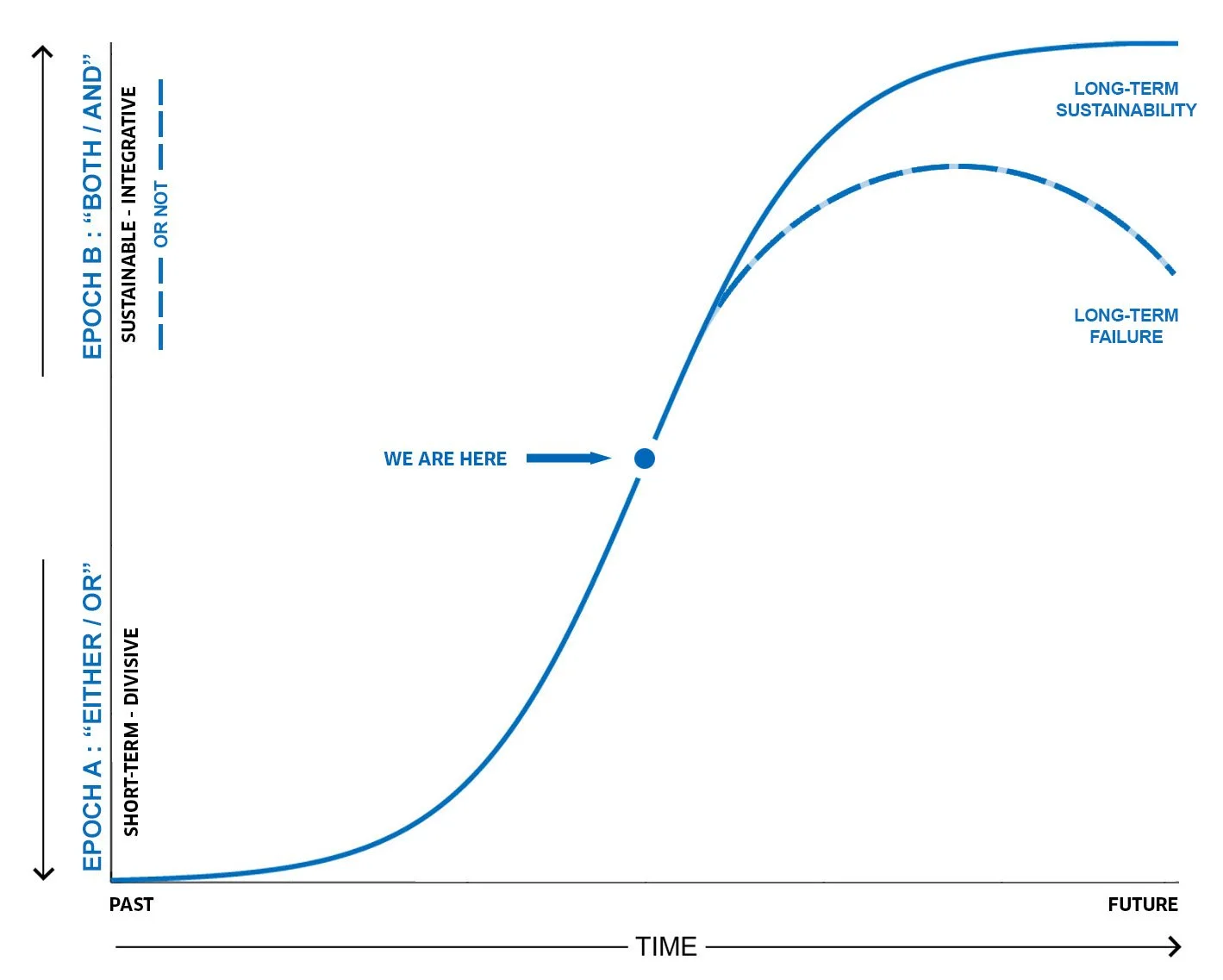
Chapter 3 Synopsis: This Is What the Inflection Point Looks Like
History rarely announces its turning points in advance. From inside the moment, periods of structural transition tend to feel chaotic, contradictory, and difficult to interpret. Only later do they appear inevitable.
This chapter explores the possibility that we are living through one of those inflection points now. Technological capability is compounding exponentially, while institutional adaptation remains incremental and slow. The resulting tension produces the strange coexistence we see everywhere: abundance alongside insecurity, connectivity alongside fragmentation, progress alongside deep unease.
Rather than treating today’s turbulence as evidence of decline, Jonas and Jonathan Salk’s use of the sigmoid curve to explain our current inflection point suggests it may be characteristic of systems under structural stress — systems whose underlying rules were optimized for a different era. Inflection points are uncomfortable precisely because the old equilibrium is no longer stable, but the new one has not yet cohered.
Understanding this dynamic does not predict the future. But it does offer a different lens through which to interpret the present — one that replaces simple narratives of failure with a more demanding question: what, exactly, is trying to change?